Friday, September 2, 2011

Time to help vote your favorite broadcasters into Cooperstown


September is here again, and the National Baseball Hall of Fame is allowing fans to help get their favorite broadcaster one step closer to Cooperstown. Voting is taking place on the Hall of Fame's Facebook page now through September 30, with the finalists being announced on October 5 (the top three fan-voted selections, plus seven more selected by an exclusive panel). The winner will be announced during the Winter Meetings on December 6, "based on popularity, longevity and past voting results in the online fan balloting," according to the website. Each franchise has two candidates, along with a list of at-large candidates. Here they all are, with each current and former Sox broadcaster emphasized (courtesy of the Baseball Hall of Fame Website):

  • Arizona Diamondbacks: Greg Schulte, Daron Sutton
  • Atlanta Braves: Skip Caray, Pete Van Wieren
  • Baltimore Orioles: Joe Angel, Jim Hunter
  • Boston Red Sox: Joe Castiglione, Jerry Remy
  • Chicago Cubs: Pat Hughes, Ron Santo
  • Chicago White Sox: Ed Farmer, Ken Harrelson
  • Cincinnati Reds: Waite Hoyt, Joe Nuxhall
  • Cleveland Indians: Mike Hegan, Herb Score
  • Colorado Rockies: Jack Corrigan, Wayne Hagin
  • Detroit Tigers: George Kell, Jim Price
  • Florida Marlins: Tommy Hutton, Rick Waltz
  • Houston Astros: Bill Brown, Larry Dierker
  • Kansas City Royals: Ryan Lefebrve, Paul Splittorff
  • Los Angeles Angels of Anaheim: Dick Enberg, Jose Mota
  • Los Angeles Dodgers: Rick Monday, Ross Porter
  • Milwaukee Brewers: Merle Harmon, Bill Schroeder
  • Minnesota Twins: Dick Bremer, John Gordon
  • New York Mets: Gary Cohen, Ralph Kiner
  • New York Yankees: Michael Kay, John Sterling
  • Oakland Athletics: Ray Fosse, Bill King
  • Philadelphia Phillies: Richie Ashburn, Chris Wheeler
  • Pittsburgh Pirates: Steve Blass, Lanny Frattare
  • San Diego Padres: Ted Leitner, Eduardo Ortega
  • San Francisco Giants: Mike Krukow, Duane Kuiper
  • Seattle Mariners: Ron Fairly, Rick Rizzs
  • St. Louis Cardinals: Al Hrabosky, Mike Shannon
  • Tampa Bay Rays: Todd Kalas, Dewayne Staats
  • Texas Rangers: Mark Holtz, Eric Nadel
  •  Toronto Blue Jays: Tom Cheek, Jerry Howarth
  • Washington Nationals: Bob Carpenter, Charlie Slowes

At-large candidates: Thom Brennaman, Joe Buck, Ken Coleman, Jacques Doucet, Ernie Johnson Sr., Ned Martin, Buck Martinez, Tim McCarver, Al Michaels, Joe Morgan, Amaury Pi-Gonzalez, Phil Rizzuto, John Rooney, Steve Stone, Gary Thorne

Most of us who follow the Sox already know by this point Hawk has lost a bit off his fastball, so to speak. However, he is one of the most recognizable voices in the game, and has been the voice of Sox baseball for 26 seasons (1982-1985, 1990-present). Chicago has a long history of over-the-top "homer" announcers (see Harry Caray and Jack Brickhouse), and Hawk simply fits right in with both of them. Since you can only select one broadcaster now, do yourself a favor and vote for the ol' Hawkeroo. Remember, you can only vote once per day.

Let's get the Hawk one step closer to the Hall!

Also, for your pleasure, here are the past Ford C. Frick Award winners*, along with their primary team(s) where they became famous.

1978: Mel Allen (New York Yankees)
1978: Red Barber (Brooklyn Dodgers, New York Yankees)
1979: Bob Elson (Chicago White Sox)
1980: Russ Hodges (New York/San Francisco Giants)
1981: Ernie Harwell (Detroit Tigers)
1982: Vin Scully (Brooklyn/Los Angeles Dodgers)
1983: Jack Brickhouse (Chicago White Sox, Chicago Cubs)
1984: Curt Gowdy (Boston Red Sox, NBC Sports)
1985: Buck Canel (New York Mets, New York Yankees)
1986: Bob Prince (Pittsburgh Pirates)
1987: Jack Buck (St. Louis Cardinals)
1988: Lindsey Nelson (New York Mets)
1989: Harry Caray (St. Louis Cardinals, Chicago White Sox, Chicago Cubs)
1990: By Saam (Philadelphia A's, Philadelphia Phillies)
1991: Joe Garagiola, Sr. (NBC Sports)
1992: Milo Hamilton (Atlanta Braves, Houston Astros)
1993: Chuck Thompson (Baltimore Orioles)
1994: Bob Murphy (New York Mets)
1995: Bob Wolff (Washington Senators/Minnesota Twins)
1996: Herb Carneal (Minnesota Twins)
1997: Jimmy Dudley (Cleveland Indians)
1998: Jaime Jarrin (Los Angeles Dodgers)
1999: Arch McDonald (Washington Senators)
2000: Marty Brennaman (Cincinnati Reds)
2001: Felo Ramirez (Florida Marlins)
2002: Harry Kalas (Philadelphia Phillies)
2003: Bob Uecker (Milwaukee Brewers)
2004: Lon Simmons (San Francisco Giants, Oakland A's)
2005: Jerry Coleman (San Diego Padres)
2006: Gene Elston (Houston Astros)
2007: Denny Matthews (Kansas City Royals)
2008: Dave Niehaus (Seattle Mariners)
2009: Tony Kubek (NBC Sports, Toronto Blue Jays)
2010: Jon Miller (Baltimore Orioles, San Francisco Giants, ESPN)
2011: Dave Van Horne (Montreal Expos, Florida Marlins)

*The name of the award given to each broadcaster who is selected to the Hall of Fame.

Thursday, September 1, 2011

The Strange Case of Ozzie Guillen: Should he stay or should he go?


Dealing with the question of whether or not a franchise icon should stick around is always difficult to approach. Often times, it's because objectivity is thrown out the window, and emotions begin to take control of the decision-making process. You want to show him the door, but how do you do it? After everything he has done for the franchise? Another side of you will think that "ah, it was just a mediocre year, many other teams/players would love to trade places with us. He's worth keeping around." However, where do you draw the line for accountability?

It has reached that point for Ozzie Guillen. Before I get into whether or not he should stick around, keep in mind that Guillen is a major figure in Sox history. He played shortstop for the them from 1985-1997, garnering a Rookie of the Year award in '85, along with a Gold Glove in 1990 and three All-Star appearances. His blue-collar work ethic endeared him to many fans on the South Side, and his temperament seemed like the perfect solution for the Sox's problems following the disappointing 2003 season, when the team parted ways with the laid-back Jerry Manuel. Ozzie was the perfect choice to manage the Sox because the team needed a fiery, aggressive manager and because he was a Sox guy, through-and-through. He understood the mindset of the fanbase and he knew Chicago.

His first season saw injuries to Frank Thomas and Magglio Ordonez, the major catalysts in their offense, and the team limped to an 83-79 finish. However, the Sox did the improbable in 2005, going wire-to-wire and sweeping the World Series, something only two other teams had ever accomplished in major-league history (the 1927 Yankees and the 1990 Reds were the others). The 2006 season began with a considerable amount of promise, as the team stormed to a 57-31 mark by the All-Star break. Unfortunately, the pitching staff was gassed by that point, and the team crumbled to a disappointing 33-41 second half record, finishing 90-72. They would miss the postseason.

Since then, the Sox have been largely mediocre, save for a miserable 2007 campaign in which they lost 90 games. They reached the postseason again in 2008, but nobody was mistaking that team for the 2005 Sox or even the 2000 team.

The accountability that a manager should have for his team's success (or lack thereof) is always tricky to ascertain. Really, the players are the ones who make the manager look smart. Do you think Tony LaRussa has all of the wins he does because he's an exponentially better manager than say, Bruce Bochy? No. It's because Tony always seems to have top-notch talent on his teams (i.e. Mark McGwire, Jose Canseco, Rickey Henderson, Bob Welch, Dave Stewart, Albert Pujols, Adam Wainwright, Chris Carpenter, Jim Edmonds, etc.). If you go back to Tony's Chicago years, you will find that they are largely unimpressive (except for 1983) because...wait for it....many of his players flat out stunk.

Which brings us back to the dilemma with Ozzie this year. It's easy for people to get on him for the team's lack of success this year. However, can Ozzie make Adam Dunn bat .300? Can Ozzie make Alex Rios hit they way he did last year? Could Ozzie have made his bullpen pitch better than it did to start the season, which is a major contributor to where the team is at now in the standings? A manager cannot go out there and make his players play out of their minds, and really, he is at the mercy of their performances. Ozzie is a great manager, and an even better motivator. Do you believe that the White Sox could have made the comeback they did in 2010 had Ozzie not been a good motivator and had given up on the team?

The Sox have also played decently since the middle of May, fighting back from what could have been the start to an awful year. Unfortunately, the team has not been able to get on an extended hot streak like they did last year to move into first. Is that Ozzie's fault? While I still believe he is a great motivator, you almost have to wonder if he is still getting through to his players. Was he simply dealt a bad hand with the group he has?

Despite his puzzling lineup decisions (Dunn hitting in the middle of the order?!), if the people who were expected to be key contributors actually came through, this wouldn't be an issue. If Dunn were on pace to hit at his career norms (.244 average, 38 homers, 96 RBIs according to Baseball Reference) and if Rios were to have a similar year as last year (.284 average, 21 homers, 88 RBIs, 34 steals) the Sox wouldn't just be in first, they would be running away with the division. Instead Dunn is having a historically bad season, and Rios is reverting to his apathetic style of play he had in his final years in Toronto. Also, the bullpen has a combined 17 blown saves this season, with many of them coming in the first two months of the season (see table below). You think if that number were cut in half, things wouldn't be considerably different with the state of this team? Thankfully, the bullpen stabilized itself after the first couple of months, and they have been nailing it down since.


Nonetheless, the combination of these unfortunate events has likely led Ozzie to lose his patience, which is probably further straining his relationship with GM Kenny Williams. Ozzie is already pressuring the team into extending him beyond 2012, threatening to leave if his wish isn't granted. A public plea for an extension with the team six games back in September will not earn you many supporters. The situation appears that's Ozzie's good as gone, but I'm not so sure another manager could do a better job. The decision to get rid of him is not as easy as some think it is, nor is it a cut-and-dry issue. However, if Ozzie stays or goes, I'm fine either way.

Sunday, July 10, 2011

1991 White Sox/A's skirmish at Comiskey Park, La Russa Erupts

Ah, the joys of Youtube. Sometimes you will get to see a classic video clip of something you have never seen before, or it may be something that you have not seen in years. Well, this highlight certainly falls into the former for me, as somehow this has evaded the countless amount of "blow up" lists that you will usually see on sports networks all across the country.

The video here is from 1991, and it features the Chicago White Sox taking on the reigning three-time American League champion Oakland Athletics at Comiskey Park. A's catcher Terry Steinbach is unfortunately hit in the head by an errant pitch from Bobby Thigpen, and some of the A's players took exception to the beaning. A skirmish between the two teams was ignited, and at one point you can see 43-year-old Sox catcher Carlton Fisk and 46-year-old A's manager Tony La Russa exchange words in the heat of the battle.

However, that was not the end of it, at least for La Russa. Tony took exception to some of the questions being asked to him by a reporter, and one of the more underrated post-game blowups in sports would follow (Language alert: Some of the things said here are not safe for work):


While the A's still won the game, the 1991 season would not be kind to La Russa's bunch, as the A's finished fourth in the A.L. West with an 84-78 record, 11 games behind the eventual World Champion Minnesota Twins. The White Sox would only finish three games better than Oakland in the West that year, finishing at 87-75.

Saturday, July 9, 2011

The Ten Greatest Moments in All-Star Game History


MLB.com is featuring a campaign for fans to vote on the greatest moment in All-Star Game history, and it has come down to Cal Ripken's home run during his All-Star farewell in 2001 and Stan Musial's game-winning blast in Milwaukee in 1955 as the potential winners. I have been voting furiously for "Stan the Man," if only for the reason that I would like to hopefully see him make an on-field appearance for the final time, surrounded by both All-Star teams a la Ted Williams in 1999 and George Steinbrenner in 2008. Musial is 90 years old and has always been one of the more underrated legends in baseball history, and even though I do not particularly care for the St. Louis Cardinals, Musial is the embodiment of all that is good within their historic franchise and in Major League Baseball.

However, if I had my druthers, neither moment would be in my top three for the history of the All-Star Game. Here is my list of the top ten moments in All-Star Game history:


10.) Stan the Man ends the All-Star Game with a bang in Milwaukee, 1955.

Throughout the course of his illustrious career, Stan Musial would appear in a record 24 All-Star Games, along with hitting a record six home runs in the Midsummer Classic. However, his biggest All-Star moment came during the 1955 game at Milwaukee's County Stadium, when he lit up Boston's Frank Sullivan for a game-winning, solo home run in the 12th inning. The final score: National League 6, American League 5.


9.) Fred Lynn hits the first grand slam in All-Star Game history at Comiskey Park, 1983.

The All-Star Game was celebrating its 50th anniversary in 1983, and fittingly enough, it was held at Comiskey Park, home of the Chicago White Sox and the site of the inaugural All-Star Game in 1933. The American League was suffering through a record 11-game losing streak in the Midsummer Classic, as their last victory over the N.L. came in Detroit in 1971. However, the Junior Circuit's drought would come to an abrupt end this time, and the Angels' Fred Lynn would seal the deal with the game's first-ever grand slam in the third inning off of San Francisco's Atlee Hammaker. The slam capped off a seven-run inning for the American League, giving them a 9-1 lead. The A.L. ended their 11-game losing streak that night, crushing the N.L. 13-3.


8.) Dave Parker nails Brian Downing at the plate in Seattle, 1979.

Known as a five-tool player during his time with the Pittsburgh Pirates, right fielder and reigning National League MVP Dave Parker came through big with an outstanding defensive play for the National League. The game was knotted up at six apiece in the bottom of the eighth inning, with Cubs closer Bruce Sutter on the mound, Yankees third baseman Graig Nettles at the plate and runners on first and second with two out. Nettles lined a single to right field and the Angels' Brian Downing was making his way toward home plate from second base. His run would have been the go-ahead one for the American League, but Dave Parker would scoop up the ball and throw out Dowining at the plate on a one hop throw. The play ended the inning and preserved the tie. The N.L would go on to win the game 7-6, and Parker would be named the All-Star Game MVP.


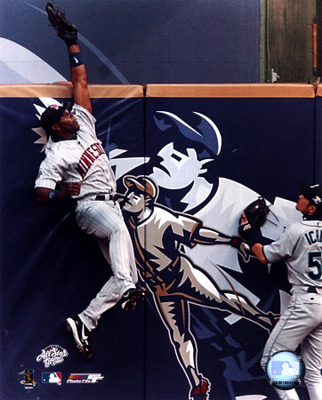
7.) Torii Hunter robs Barry Bonds in Milwaukee, 2002.

Another great defensive play would take place at Miller Park in 2002, when in the bottom of the first, Giants slugger Barry Bonds crushed a 1-1 pitch from Boston's Derek Lowe deep into right center field. The ball would have easily been a home run, but Twins center fielder Torii Hunter leaped high above the wall to take it away from the game's most feared hitter. Unfortunately due to a shortage of available players, the game ended in a flat-footed tie in the 12th inning at 7-7.


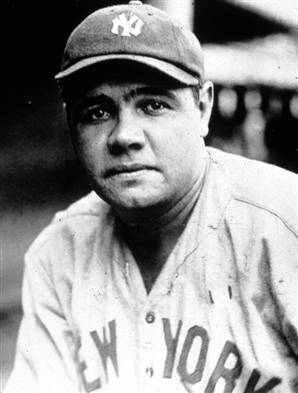
6.) Babe Ruth begins the first All-Star Game with a bang at Comiskey Park, 1933.

The game would be billed as "The Game of the Century," as the festivities were held as a part of the World's Fair that was taking place in the Windy City that summer. The White Sox's Comiskey Park played host to the first-ever All-Star Game, and the first home run would be hit by none other than Babe Ruth, when he took Cardinals' starter Bill Hallahan deep in the third inning. The A.L. would go on to win the game, 4-2, and a Midsummer tradition was born.


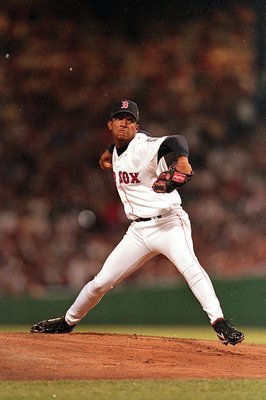
5.) Boston's Pedro Martinez dazzles the hometown crowd with a flurry of strikeouts, 1999.

During the Steroid Era, there were not too many pitchers who stood out for their on-mound excellence. However, the Red Sox's Pedro Martinez would be one of the few exceptions, as he would finish 1999 with one of the best seasons in recent memory by a pitcher. His performance in the All-Star Game would be the defining moment of his Cy Young season that year, striking out the first four N.L. hitters (Barry Larkin, Larry Walker, Sammy Sosa and Mark McGwire) in perhaps one of the most intimidating All-Star lineups in history. The A.L. won 4-1 and Martinez would garner the All-Star Game MVP for his impressive effort.


4.) A 15-inning thriller in the Bronx, 2008.

Old Yankee Stadium's final year was in 2008, and it would not go out quietly hosting its final All-Star Game, as the contest lasted 15 innings in what could arguably be the finest Midsummer Classic ever played. The N.L. appeared to be on the fast-track to winning the game in the bottom of the seventh, when Reds' pitcher Edinson Volquez could not hold the lead, surrendering a two-run homer to Boston's J.D. Drew to tie the game. In the following frame, the N.L. would re-take the lead on a Adrian Gonzalez sacrifice fly, but the A.L. rallied to tie the game again in the bottom of the eighth, when an Evan Longoria ground-rule double scored Grady Sizemore to even things up at three.

The game marched on to extra-innings, and the drama continued. Rockies pitcher Aaron Cook managed to work out of a bases-loaded, no out jam in the bottom of the 10th, while Pirates center fielder Nate McClouth made his best Dave Parker impression in the bottom of the 11th, throwing out Tampa Bay's Dionner Navarro at the plate. Both teams managed to get people on, but neither one could scratch another run across until the bottom of the 15th, when Michael Young's sac fly scored Justin Morneau to win the game. Fittingly enough, the final play even had plenty of drama, as Morneau barely slid in ahead of the throw from Milwaukee's Corey Hart.


3.) Pete Rose takes out Ray Fosse at home plate in Cincinnati, 1970.

Riverfront Stadium was not even a month old when it hosted its first All-Star Game in 1970, and what a game it was! The game would mark the first time since 1957 that the fans could vote for the game's starters, and the people of Cincinnati were treated to a classic, as the game was tied at four heading into the 12th. With Pete Rose on second and two out, the Cubs' Jim Hickman lined a Clyde Wright offering into center field for a base hit. Royals center fielder Amos Otis came up firing and there would be a dramatic play at the plate. Rose, demonstrating the hard-nosed style of play that endeared him to fans in Cincinnati, crashed into Cleveland's Ray Fosse at home, scoring the game-winning run. The National League won by a score of 5-4, but the promising career of Ray Fosse would be nearly lost, as he suffered from a severely injured shoulder as a result of the collision. While Fosse would play another nine seasons and capture two World Series rings with the Oakland A's, he would never regain the level of play that made him so promising during the 1970 season.


2.) Reggie Jackson's titanic blast at Tiger Stadium in Detroit, 1971.

Sure there have been other gargantuan blasts hit in All-Star competition (Johnny Bench's center field, upper deck shot during the game as Jackson's blast and Bo Jackson's titanic shot in Anaheim 18 years later come to mind), but neither one holds a candle to Reggie's moon shot. In the bottom of the third with one on, Jackson connected with a hanging slider from Pittsburgh's Dock Ellis that wound up hitting the light standard high above the right center field roof. The home run went an estimated 520 feet, and it would help spur the A.L. to a 6-4 victory, their first since 1962.


1.) Carl Hubbell strikes out a quintet of future Hall of Famers at the Polo Grounds, 1934.

In one of the defining moments of the career of Hall of Fame lefty Carl Hubbell, the screwballing lefty would strike out Babe Ruth, Lou Gehrig, Jimmie Foxx, Al Simmons and Joe Cronin all in succession during the first and second inning of the second-ever All-Star Game. All five hitters would go on to make the Hall of Fame, and in an era where players did not strike out nearly as much as they do today, the feat is all the more impressive. The record of five consecutive strikeouts would only be matched by the Dodgers' Fernando Valenszuela in 1986, but the five he struck out (Don Mattingly, Cal Ripken, Jr., Jesse Barfield, Lou Whitaker and pitcher Ted Higuera)- while impressive- does not hold a candle to what "King Carl" did before his home crowd on July 10, 1934.

Saturday, July 2, 2011

The Greatest Pitching Duel in Baseball History


Before July 2 comes to a close, I thought I would inform you baseball fans out there of a very special anniversary.

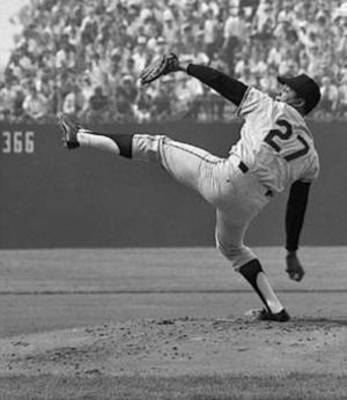
On this day in 1963, future Hall of Fame pitchers Juan Marichal and Warren Spahn locked horns in perhaps the most epic pitching duel of all-time. The game went scoreless into the 16th inning, with both starting pitchers still on the hill!

Giants manager Alvin Dark tried several times to take Marichal out of the game, but "The Dominican Dandy" refused, saying that as long as the 42-year-old Spahn was still out there, he was staying in (Marichal was only 25).

Willie Mays would end the game with a walk-off homer off of Spahn in the bottom of the 16th, as the Giants won 1-0.

What a game!

Here is the boxscore from the game, courtesy of Baseball-Reference.com.

It's easy to say that we will never see a game quite like this one ever again.

Saturday, June 25, 2011

Last Night's Loss a Truly Painful One


After witnessing this team pull off their improbable World Series victory six years ago, there are not too many games (regular season or otherwise) that will have me feeling badly after defeat. However, last night's game tested my patience considerably.

There are not too many games where you will see a team comeback three times after the 8th inning to tie the game, but that's what the White Sox did last night. They trailed Washington 3-0 entering the bottom of the 9th inning, when pinch-hitter Mark Teahen hit a game-tying, three-run homer off of Drew Storen. Making things even more improbable, the homer was only his second of the season.

The euphoria that came with that homer unfortunately did not last, as Lance Nix broke the tie in the top of the 10th with a solo homer to give the Nats a 4-3 lead. Undeterred, the Sox tied the game again in the bottom half of that frame on a Todd Coffey wild pitch. One of the more aggravating parts of this game came in Brent Lillibridge's at-bat following wild pitch. Not only did Lillibridge miss the most epic hanging breaking ball of all-time during his at-bat, Coffey threw a pitch far enough inside to Lillibridge where it could have hit him and won the game. However, Lillibridge jumped out of the way of the pitch. The pitch was waist-high on the inner-half, you have to take one for the team, Brent! Nonetheless, he struck out, which effectively killed that inning's rally. Teahen would fly out to end the inning and send the game deeper into the night.

The Nats took a 5-4 lead in the 12th inning, and were one strike away from ending the game when A.J. Pierzynski tied it with a solo home run. I thought to myself afterwards: "Good fortune has to fall the Sox's way tonight, right?"

Well, no. They were one out away from getting out of a sticky situation in the top of the 14th, when Alexei Ramirez's throwing error ended up plating another go-ahead run for the Nationals. Washington would tack on three more runs after that, and would win the game 9-5 in 14 tense, agonizing innings.

The Sox currently sit at 37-40, just 4.5 games out of first. However, if you have watched the Sox all year, 4.5 games almost feels like 8.5. They can never show any signs of consistency. Everytime they have a golden opportunity to make up some ground in the division, it seems like they squander it. Last night, Detroit, Cleveland and Minnesota each lost, which would have put the Sox in a great situation to make up ground in the division, while widening the gulf between them and Minnesota. Unfortunately, that did not come to pass.

With the Sox only four games away from the mathematical half-way point in the season (81 games), you almost wonder if this is who they are, a team that will be lucky to finish with 83 wins. The way they have played up until this point of the season has not exactly filled me with dreams of seeing them play in October.

Oh well. Here's to hoping the Sox can win the next two against the Nasty Nats.

Friday, June 17, 2011

At long last, I'm finished with school! Now, some thoughts on realignment, the DH and interleague play


Folks, I am proud to say that I am officially finished with college! I graduated last week with a B.A. in Journalism from the University of Cincinnati, and I am more than relieved that my five-year journey of obtaining a college education is finally over.

Now, back to business here on the "South Side Hit Parade." Recently, there have been some rumblings that MLB may consider some form of realignment. Nobody is really sure how the teams will be realigned at this point, but some suggestions have been offered. The one that appears to have the most talk surrounding it right now would be to move the Houston Astros to the American League West, and have interleague play year-round. Some other suggestions include moving either the Colorado Rockies or the Arizona Diamondbacks to the American League West, if only for the reason that they are two of the newer NL teams, and because they would each give the Rangers a time zone buffer (Texas is a Central Time Zone team, while the A's, Angels and Mariners are all in Pacific Time. Ouch.).

While some old-school folks may have a problem with year-round interleague play and realignment, I actually look forward to seeing something like this happen. I have always enjoyed interleague play, and it always seemed a bit bizarre to me to sequester this to just one portion of the season. If you have it year-round, it would solve the problem of "unfair" scheduling, such the Cardinals playing the Royals six times, while the Reds play the Indians six times (Never mind the fact the Reds are 1-5 against K.C. in their last six games against them, including losing two of three to them at home last year).

Another benefit to having year-round interleague play would likely mean that the National League will finally get with the times and adopt the Designated Hitter. Listen, I do not mind the differences between the leagues at the moment. However, I am starting to prefer the American League style of play. I do not care about losing the "strategy" of the game by having the pitcher in the batting lineup. There is still plenty of strategy in American League baseball, as there is in any baseball game, DH or no DH. However, I prefer to watch Vladimir Guerrero hit than to watch Tony Larussa think. There is a lot more excitement with watching Paul Konerko step to the plate in a big situation as opposed to watching Dusty Baker using the double-switch late in a game. Change can be good in the game of baseball sometimes, and it would be for the better if the National League finally adopted the DH. There would be more balance between both leagues, and you could easily have interleague play year-round.

One more thought for the evening: Even if realignment and year-round interleague play never happens, what in the hell is wrong with interleague play right now? People love to complain about it, citing the scheduling inequities teams have. It is not that big of a deal. It is just 16-18 games out of 162. Over the course of 162 games, the cream is going to rise to the top. There are no flukes; any team that makes the playoffs has earned it. If you miss the playoffs by one or two games, you can point your finger at several reasons why you failed to make it other than your interleague record. If you miss by five or six games, then you just were not good enough to make it, even if you do have a better record than a postseason team in another division. I was very upset when the White Sox missed the 2006 postseason with 90 wins, despite the fact they would have won the sad-sack NL Central by 7.5 games over the Cardinals. However, baseball, like life, is not always fair.

That's all I have for you now, talk to you soon!